Mindfulness Retreats Near Cascais: Where to Go and What to Expect
Cascais and the surrounding Sintra-Cascais Natural Park offer some of Portugal's most beautiful settings for mindfulness retreats. Here's a practical guide to what's available.
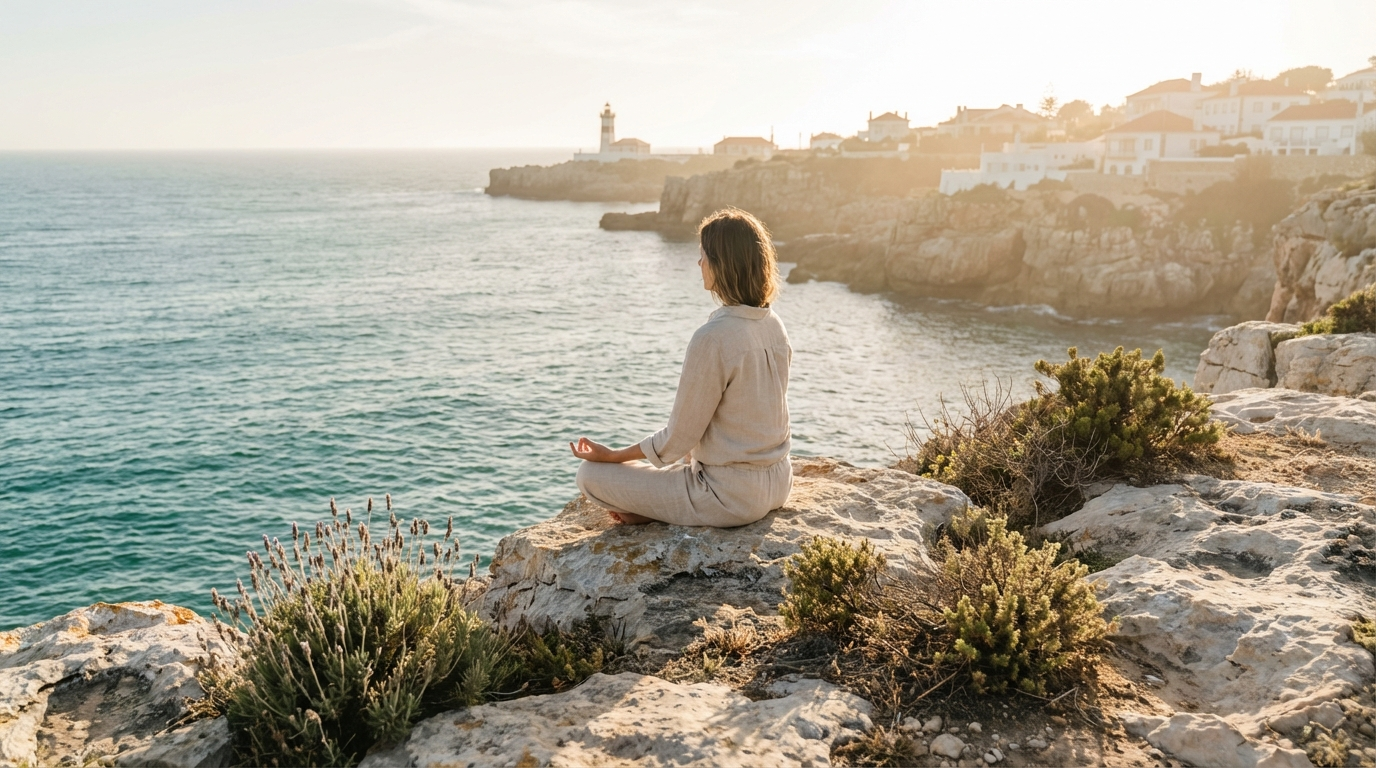
Cascais sits at the point where the Tagus meets the Atlantic — a town shaped by the sea, accustomed to a slower rhythm than Lisbon's 30 minutes up the coast. The Sintra-Cascais Natural Park stretches behind it: pine forests, granite outcrops, windswept clifftops. It's a landscape that does some of the mindfulness work before you even begin.
This guide covers what mindfulness retreats near Cascais look like in practice, what distinguishes the good ones, and how to find what you're looking for.
What "Mindfulness Retreat" Actually Means Here
The term covers a wide range. At one end: a structured silent retreat following the Buddhist vipassana tradition, with 10 hours of formal sitting practice per day and no talking for the duration. At the other: a weekend in a nice house with some gentle yoga in the morning and a session on "mindful eating" before lunch.
Neither is inherently better — they serve different needs and different people. The important thing is knowing which you're booking before you arrive.
Day Programmes vs. Residential Retreats
Day Programmes
Several spaces in and around Cascais run day or half-day mindfulness programmes. These are well suited for:
- People who want to experience what structured practice feels like before committing to a longer retreat
- Those with family or work commitments that make overnight retreats difficult
- Residents of the Cascais-Lisbon corridor looking for something local
Day programmes typically run 5–7 hours, often starting with an early arrival, guided sitting and walking meditation, a shared vegetarian lunch (usually eaten in silence), more practice in the afternoon, and a closing circle.
The Sintra hills — just inland from Cascais — have several locations that offer these programmes in extraordinary natural settings. The microclimate there (notably cooler and more atmospheric than the coast) suits contemplative practice.
Residential Retreats
The Sintra-Cascais area has a handful of residential retreat centres that host multi-day programmes. Most are in converted quintas — old Portuguese farmhouses — with gardens, simple rooms, and the kind of quietness that's hard to find close to a major city.
Typical structure for a 3-day retreat:
- Arrival afternoon, orientation, opening session
- 2 full days of practice (sitting meditation, walking meditation, body scan, optional yoga, dharma talks or guided inquiry sessions)
- Closing morning, departure after lunch
Longer retreats (5–7 days) tend to go deeper and are more likely to include silence as a continuous commitment rather than just during certain periods.
Meditation Traditions Represented in the Area
Mindfulness-Based Stress Reduction (MBSR)
The secular, clinically developed programme created by Jon Kabat-Zinn at UMass Medical School. MBSR is the most evidence-based mindfulness approach — hundreds of peer-reviewed studies support its effectiveness for stress, chronic pain, anxiety, and depression.
Certified MBSR teachers must have completed the Oasis Institute's teacher training or equivalent. Several teachers in the Cascais-Lisbon area are certified. The 8-week MBSR programme is taught as a weekly course rather than an intensive retreat, but some teachers run retreat days as part of or following the programme.
Vipassana (Insight Meditation)
Rooted in Theravada Buddhist tradition. The emphasis is on directly observing the changing nature of experience — sensations, thoughts, emotions — without interference. Silent retreats in this tradition can be genuinely transformative for people ready for that intensity.
Portugal has several teachers trained in the Insight Meditation tradition, some with decades of practice. The Cascais area has a small but dedicated community.
Zen
Less common in the Cascais area than in Lisbon, but worth knowing about. Zen emphasises direct experience over conceptual understanding, and its retreat format — the sesshin — is notably more rigorous than most Western mindfulness retreats. Not a starting point for beginners.
Non-Denominational / Contemporary Mindfulness
Most commercial retreats near Cascais fall here. The teaching draws loosely from Buddhist sources but presents itself in secular, accessible language. This is entirely valid — the practices are real — but the quality of teaching varies considerably without the standardisation that comes with certified secular programmes or established religious lineages.
The Sintra Connection
Sintra is 20 minutes inland from Cascais and deserves mention in any guide to mindfulness in the area. Its UNESCO-listed landscape — forested hills, Moorish palaces, Atlantic fog rolling in even on warm days — creates a particular atmosphere. Several retreat facilitators specifically run programmes in Sintra because of this.
The town itself is extremely touristy, but retreat spaces are typically on the outskirts, in the natural park. The contrast between the quiet of the forest and the noise of the town reinforces what mindfulness practice asks you to notice: the difference between being caught in busyness and having some perspective on it.
Practical Considerations
When to go: Spring (March–May) and autumn (September–November) are ideal. The summer heat can make afternoon practice uncomfortable, and July–August brings tourist traffic that affects the surrounding roads. Winter is mild and quiet — January and February retreats have a particular quality.
What to bring: Comfortable layers (the coastal wind and Sintra microclimate mean temperatures can change quickly), something warm for morning sessions, and a willingness to put your phone away. Most retreat spaces will ask you to do this, and the better ones will explain why rather than just confiscating it at the door.
What to leave behind: Expectations about what "results" should look like. Mindfulness practice is observation-based, not goal-directed. People who approach retreats as a productivity hack tend to find them frustrating. People who approach them with genuine curiosity, even without a clear goal, tend to find them valuable.
Questions to Ask Before Booking
- What meditation tradition does the programme draw from?
- What is the teacher's training and how long have they been practising?
- Is silence maintained throughout, or only during certain periods?
- What is the group size?
- Are there any contraindications — situations where you'd recommend someone not attend?
That last question is important. A good retreat teacher will acknowledge that intensive meditation is not appropriate for everyone in all circumstances, particularly people in acute mental health crises. Anyone who claims their programme is suitable for everyone should be approached with caution.
A Note on Cost
Day programmes near Cascais typically run €60–120. Residential retreats vary widely: €250–450 for a weekend at a well-run centre, more for programmes with international teachers. Some centres operate on a dana model (voluntary donation from the Buddhist tradition of generosity), though this is more common in the city than in the Cascais area.
The price rarely correlates with quality. Some of the most rigorous and valuable retreats charge modestly because they're run by teachers who aren't trying to build a business.
Starting Point
If you've never done a mindfulness retreat before, a half-day or day programme in the Sintra-Cascais area is a reasonable starting point. It gives you a feel for extended formal practice without the commitment of an overnight retreat, and the natural setting does a lot of the initial work of helping the mind settle.
From there, if it resonates, a 3-day residential retreat will take you significantly further. The first full day of any residential retreat is typically the hardest — the mind accustomed to constant stimulation pushing back against stillness. The second day is where something often shifts. The third day is where you start to understand why people keep coming back.