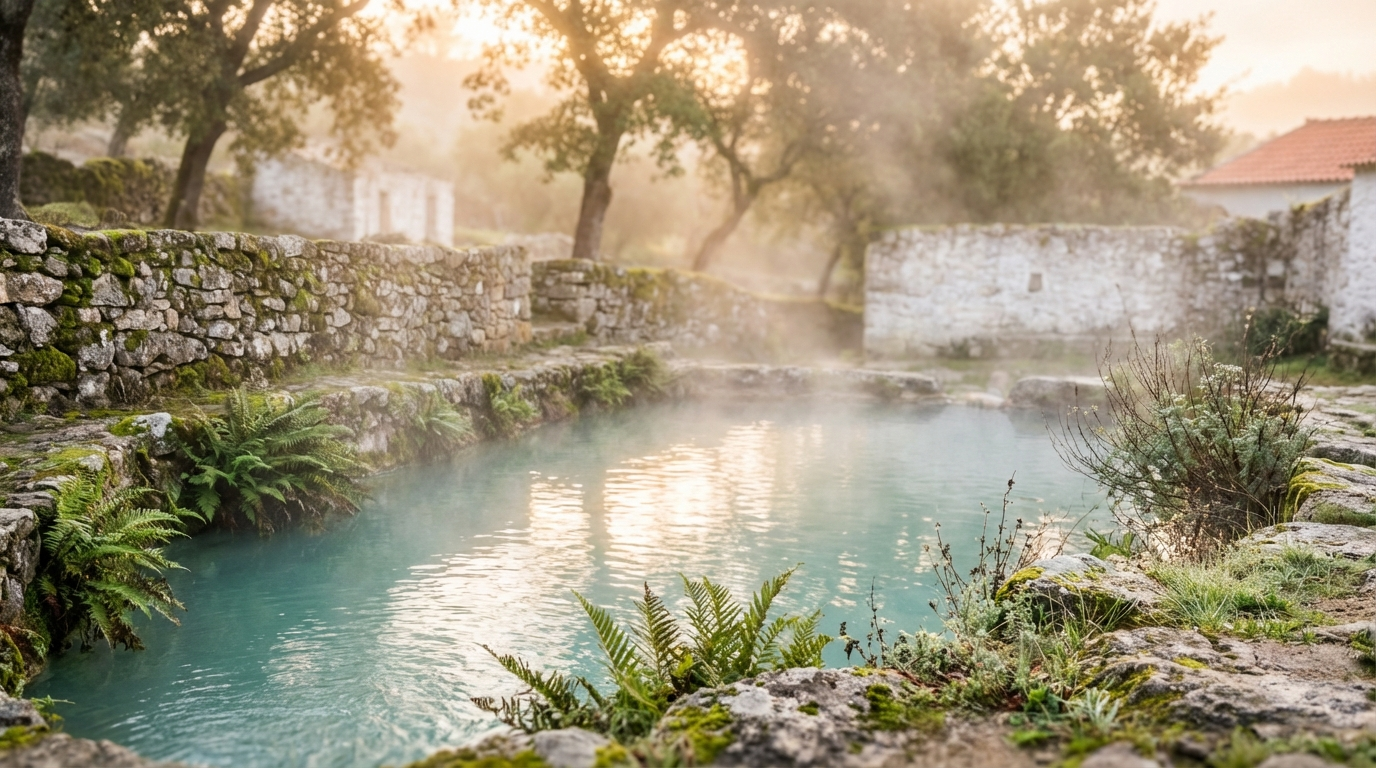
Portugal's Thermal Springs: Ancient Healing Waters for Modern Wellness
Portugal has one of Europe's richest traditions of thermal bathing. From the Minho to the Algarve, mineral-rich springs have been used for healing for thousands of years. A guide to the best.
Portugal is a country of water. Not just the Atlantic that defines its western edge and southern coast, but water beneath: thermal springs that rise through granite and schist, carrying minerals accumulated over millennia. Romans knew this. The Portuguese have known it for centuries. The contemporary wellness industry is only now catching up.
The country has over 50 classified thermal spas (termas) and several natural hot springs that remain essentially unimproved — places where water emerges from the earth at temperatures between 20°C and 75°C, saturated with sulphur, fluoride, bicarbonates, and other minerals that have genuine therapeutic effects on specific conditions.
The Tradition
The word termas carries weight in Portuguese culture. Before the National Health Service, thermal cures (curas termais) were a serious medical intervention — doctors prescribed specific springs for specific conditions, patients came for two-to-three-week residential treatments, and the estalagem (thermal inn) was a well-understood institution.
That medical framework weakened during the second half of the 20th century, replaced first by the growth of conventional medicine, then by the rise of luxury spa culture that used thermal waters more as ambiance than therapy. There is now a partial return to therapeutic use — several Portuguese thermal establishments have rebuilt their medical programmes, with physicians specialising in balneology (the medical use of bathing) on staff.
What Mineral Waters Actually Do
This is worth understanding before visiting, because the claims on brochures vary considerably in quality.
Sulphurous waters: Sodium sulphide content has demonstrated anti-inflammatory effects on the respiratory system and skin. Traditionally used for bronchitis, sinusitis, eczema, and psoriasis. The smell (characteristic hydrogen sulphide) is off-putting but harmless. Several studies support use for respiratory conditions.
Bicarbonate waters: Neutralise gastric acidity, support the digestive system. Drunk (not just bathed in) as part of therapeutic programmes. Commonly recommended for gastritis and metabolic conditions.
Radioactive waters (radioativas): Several Portuguese springs contain low levels of radon. The evidence for the therapeutic effects of low-dose radiation (hormesis) is contested but real enough that these springs maintain credibility in the medical literature. Traditionally used for rheumatism and arthritis.
Fluoridated waters: Support dental health. Some springs are specifically recommended for this application.
Ferruginous waters (iron-rich): Often drunk rather than bathed in. Used for anaemia and iron deficiency.
The key distinction: you are choosing a spring based on its specific mineral composition and its known therapeutic applications, not simply because the water is warm.
Northern Portugal
Chaves
The most significant thermal town in mainland Portugal, in the north near the Spanish border. The Flaviae springs have been in use since Roman times — the name Chaves derives from Aquae Flaviae, the Roman name for the settlement that grew around them. Water temperature around 73°C. Primarily sodium bicarbonate and fluoride composition.
The town itself has thermal infrastructure from the early 20th century, some beautifully preserved. The medical spa offers formal therapeutic programmes as well as shorter recreational visits. The surrounding Trás-os-Montes region is one of Portugal's most undervisited landscapes — dramatic, medieval in feeling, extraordinary for anyone who wants immersion in a genuinely different Portugal.
Vidago
Also in the Chaves region, with elegant belle époque infrastructure built by the Companhia das Águas de Vidago e Pedras Salgadas in the early 1900s. The Vidago Palace Hotel, restored after years of neglect, now offers high-quality thermal treatments alongside the sort of luxury accommodation that existed in the original thermal tourism tradition.
The Vidago water is specifically carbonate and sodium — extensively used for digestive and metabolic conditions, and also simply delicious to drink, which makes it easy to consume the quantities needed for therapeutic effect.
Caldas do Gerês
Inside the Peneda-Gerês National Park, Portugal's only national park. Thermal springs at around 46°C, sulphurous, with a long tradition of use for respiratory and dermatological conditions. The setting — deep green forested valleys, granite mountains, waterfalls — makes this exceptional for anyone combining thermal bathing with walking or nature immersion.
The infrastructure is simpler than Chaves or Vidago but the water and environment are remarkable.
Central Portugal
Termas de Monfortinho
In the border region with Spain, isolated and genuinely tranquil. Bicarbonate and fluoride waters at around 18–20°C. Primarily used in therapeutic programmes for kidney and urinary tract conditions. The cool temperature requires indoor pools rather than outdoor bathing.
The isolation is an asset if what you want is a proper retreat — there is genuinely little else to do here, which concentrates the mind on the cure.
Serra da Estrela Region
Several springs in the foothills of Portugal's highest mountain range. Cooler than northern springs, primarily used for their radioactive properties. The Serra da Estrela landscape — sheep cheese, rye bread, winter snow — is the most continental-feeling part of Portugal.
Southern Portugal
Monchique (Algarve)
The thermal springs of the Serra de Monchique rise from the highest point in the Algarve at around 32°C. The water here is particularly soft — low mineral content — and alkaline, with long traditional use for digestive conditions.
The location is spectacular: the mountains above Portimão, with orange and medronho (arbutus) trees covering the slopes, cooler and greener than the coastal Algarve below. The thermal spa at Monchique was extensively rebuilt in the 21st century and offers modern facilities.
The Azores: Geothermal Swimming
The Azores deserve a separate category. These volcanic islands sit on the Mid-Atlantic Ridge, with geothermal activity as a constant feature of the landscape. The thermal pools here are a different experience from mainland springs — warmer, more visually dramatic, embedded in volcanic crater landscapes.
Furnas, São Miguel: The village of Furnas is built around geothermal activity so intense that locals cook cozido stew in pots lowered into the ground. The thermal pools in the Parque Terra Nostra — surrounded by 200-year-old camellias and tree ferns — are some of the most beautiful bathing in Europe. Water temperature around 39°C. Iron-rich and visually striking (the iron stains everything it touches orange).
Caldeira Velha, São Miguel: A natural hot spring waterfall in the forest, with a small pool at around 35°C. Free to enter, simple infrastructure, genuinely wild feeling. This is not a spa — it's the earth producing warm water in a forest, which is what it is.
Terceira and Faial: Other islands have thermal sites of varying accessibility. The Azores Government has been developing the geothermal tourism infrastructure; what was difficult to access a decade ago is increasingly well-organised.
Practical Notes
When to go: Northern thermal towns are most atmospheric in the shoulder seasons — spring and early autumn. Summer brings more visitors and heat. Winter, particularly at Caldas do Gerês, can be wet but is also when the landscape is most dramatic and the spas least crowded.
Medical consultation: For serious therapeutic use of thermal springs, a consultation with a balneologist (a physician specialising in thermal medicine) before the programme is worth the investment. They can direct you to the spring most appropriate for your specific condition and design a dosage programme.
Duration: The therapeutic tradition requires minimum stays of one to two weeks for meaningful physiological effect. Weekend visits can be restorative but are primarily recreational. If you're coming for a specific medical reason, plan accordingly.
Water quality: All classified Portuguese thermal establishments are subject to regular water quality analysis. This is a regulated sector with established safety standards.
A Note on Expectation
Thermal bathing is not a cure-all, and the more extravagant claims about miracle springs should be approached critically. What the evidence supports, and what centuries of use have demonstrated, is more modest and more real: specific mineral compositions have specific therapeutic effects on specific conditions; regular bathing in appropriate waters produces genuine physiological changes; the combination of warm water immersion with the relaxation response and, often, beautiful natural environments produces measurable improvements in stress, sleep, and chronic pain management.
Portugal's thermal heritage is worth engaging with on those honest terms. The waters are real. The tradition is deep. The experience, approached with appropriate expectations, is restorative in ways that go beyond what the science has yet fully explained.