Sound Healing in Portugal: A Guide to Gongs, Bowls, and Voice
From ancient stone chapels in the Alentejo to modern studios in Lisbon, sound healing has found fertile ground in Portugal. A guide to what's available and what to expect.
Sound has always been part of Portugal's spiritual landscape. The fado houses of Lisbon, the Gregorian chant that still drifts from Alentejo monasteries, the Atlantic waves that define the western edge of the continent — sound here carries a particular weight. It's no surprise that sound healing has found such receptive ground.
What Is Sound Healing?
Sound healing uses specific frequencies and vibrations to influence the body's nervous system, brainwave states, and emotional patterns. The mechanisms are partly understood: sound waves directly affect the autonomic nervous system, certain frequencies promote the transition from beta (active thinking) to alpha and theta (relaxed, meditative) brainwave states, and the vibration of instruments like gongs and crystal bowls is physically felt as well as heard.
The claims vary widely across practitioners. The more grounded ones position sound as a tool for relaxation, stress reduction, and supporting existing therapeutic work. Others make broader assertions. The evidence base is growing but not yet definitive — which means approaching sound healing with curiosity rather than fixed expectations is probably the right posture.
The Main Instruments
Tibetan Singing Bowls
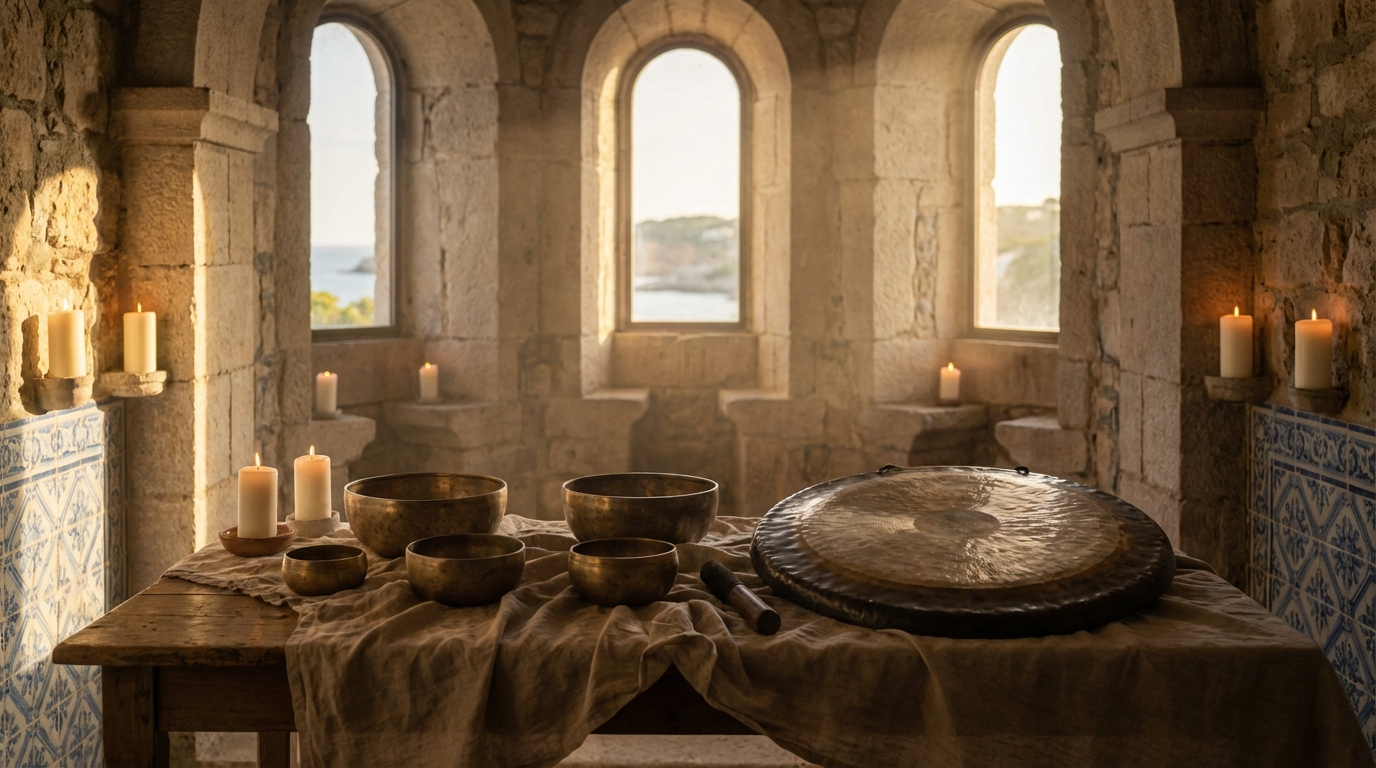
The most widely available sound healing modality in Portugal. Metal bowls, traditionally from Tibet and Nepal, produce complex multi-harmonic tones when struck or circled with a mallet. A skilled practitioner uses them individually for specific areas of the body, or in groups to create sustained harmonic fields.
Quality matters enormously. Hand-hammered antique bowls from Nepal produce richer, more sustained tones than machine-made copies. Practitioners who have trained directly with Tibetan or Nepalese teachers tend to work with better instruments and more intentional technique.
Crystal Bowls
Made from crushed quartz, crystal bowls produce a cleaner, purer tone than metal bowls — often more penetrating and intense. Some people find crystal bowl sessions more disorienting than Tibetan bowl work; others find them more powerful. The experience is genuinely different.
Crystal bowl practitioners often work with specific frequencies tuned to particular intentions, though the scientific basis for this mapping is thin.
Gongs
Large gongs — particularly planetary gongs tuned to specific astronomical frequencies — have become increasingly popular in Portugal. A gong bath (lying in the sound field of one or more large gongs played continuously for 45–90 minutes) can be a profoundly disorienting experience, moving from recognizable sound through chaos into deep silence.
Not suitable for everyone: the intensity can be overwhelming for people with anxiety disorders, PTSD, or certain hearing sensitivities. Responsible practitioners ask about this in advance.
Voice and Toning
Overtone chanting, sacred sound circles, and group toning workshops are less visible than bowl-based work but arguably more accessible. The human voice is an instrument everyone possesses. Learning to work with your own voice as a healing tool — breath support, resonance, extended tones — can produce remarkable physiological shifts.
Several practitioners in Lisbon and the Alentejo work in traditions rooted in Mongolian khoomei (throat singing), Central Asian sacred music, and indigenous vocal traditions.
Where to Find It
Lisbon
The city has the most practitioners and the most regular programming. Studios in Príncipe Real, Santos, and Mouraria run weekly sound meditation sessions alongside yoga and meditation classes. Drop-in is usually possible; booking in advance for anything billed as a ceremony or special event is advisable.
Several practitioners run sound healings from their homes in the older neighbourhoods — these tend to be smaller (4–8 people) and often have a more focused quality than larger public events.
Sintra and Cascais
The Sintra hills have drawn esoteric practitioners for centuries. Several sound healers work in private spaces in the natural park area, often combining sound with nature-based practices. These sessions are typically more expensive and more exclusive than city offerings — and the setting does significant work.
Alentejo
The combination of near-total silence (genuine quiet, the kind increasingly rare in Europe), ancient stone buildings, and the spatial quality of the landscape makes the Alentejo arguably the best context in Portugal for sound healing work. Several retreat centres in the region incorporate sound into their programming. A handful of dedicated practitioners run ceremonies in converted stone chapels and farmhouses.
The acoustics of old Portuguese stone architecture are extraordinary. A single bowl in a 16th-century chapel sounds entirely different from the same bowl in a modern studio.
Azores
Emerging. The volcanic landscape of the Azores — with its geothermal activity and the particular resonance of basaltic rock — creates unusual conditions for outdoor sound practice. A small number of practitioners are working there, mostly running retreats rather than regular sessions.
What to Expect in a Session
A typical group sound healing in Portugal runs 60–90 minutes. The format:
- Arrival and brief settling-in (participants usually lie on yoga mats with blankets)
- Opening intention-setting (varies by practitioner — some use breath exercises, some silence, some a brief spoken introduction)
- The sound journey itself — typically 45–75 minutes
- Quiet integration time at the end
- Often a brief sharing circle for those who want it
You may experience: vivid imagery, emotional releases (tears are common and considered normal), physical sensations, altered time perception, unusual depth of relaxation, or — equally valid — nothing in particular beyond feeling rested.
The experience is highly variable and not predictable. Two people in the same session can have entirely different responses. This is not a malfunction of the modality — it's a feature of working with consciousness.
Choosing a Practitioner
There is no regulated qualification for sound healing in Portugal. This means quality is highly variable.
Indicators of seriousness:
- Extended training with a recognised teacher or lineage (3+ years of dedicated study)
- Experience: regular practice over multiple years, not a recent pivot from another field
- Clear communication about what to expect and what the practice is and isn't
- Pre-session health screening: asking about any conditions that might contraindicate intense sound work
- Professional instruments: hand-hammered bowls, well-maintained gongs
Indicators to be cautious about:
- Extravagant claims about curing disease or addressing serious psychological conditions through sound alone
- Reluctance to discuss training background
- Combining multiple modalities in one session in ways that feel unfocused
The Portuguese Context
There's a local tradition here that resonates with sound healing. Portugal's ermidas — small rural chapels, many abandoned — acoustically perfect spaces with centuries of prayer and music in their walls. The country's relationship with melancholy and longing (saudade) makes it particularly fertile ground for practices that work with emotional depth.
Sound healing arrived here via international wellness culture, but it has found something genuinely native to connect with. The best practitioners are those who understand both dimensions — the universal language of vibration, and the particular quality of this landscape.