Where Can Women Find Empowerment-Focused Yoga Retreats in Portugal?
Compare Portugal's best women's empowerment retreats with real pricing, trauma-informed approaches, and solo traveler insights. From Alentejo to Algarve.
You've been scrolling through retreat websites for weeks now, bookmarking and comparing, trying to figure out which one will actually help you feel like yourself again. The photographs all look beautiful, but you're not looking for a beautiful vacation. You're looking for something that will help you reconnect with the part of yourself that's been buried under years of taking care of everyone else.
Women's yoga retreat Portugal empowerment programs have grown significantly in the past few years, and Portugal has become one of Europe's most sought-after destinations for this specific type of transformative work. Unlike the yoga retreats your friend went on in Bali or the wellness spa weekend you took last year, empowerment-focused retreats for women center on something deeper: reclaiming your sense of self, processing what your body holds, and building genuine connection with other women doing the same work.
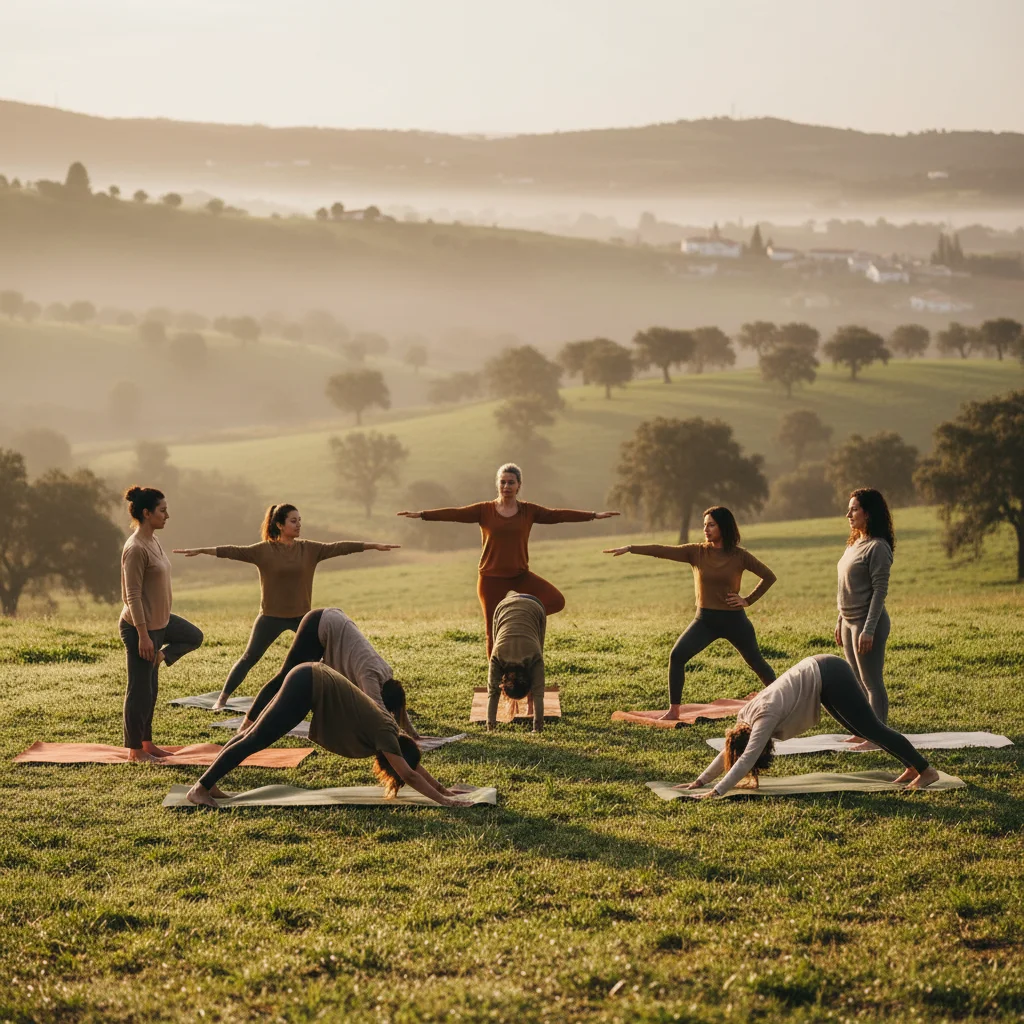
Portugal's landscape, from the wild rolling hills of Portalegre to the healing coastline of the Algarve, creates the right conditions for this kind of inner journey. The country's spiritual culture, combined with its affordability compared to other Western European wellness destinations, has attracted facilitators who specialize in trauma-informed practices, somatic work, and sacred feminine teachings.
What Makes Women's Empowerment Retreats Different from Traditional Yoga Retreats in Portugal?
When you book a traditional yoga retreat, you can generally expect two daily asana classes, vegetarian meals, and perhaps some meditation or pranayama sessions. You'll likely spend your days perfecting your warrior pose, working toward arm balances, and leaving with a more flexible body.
Empowerment-focused retreats work from an entirely different foundation. The yoga practice, while present, serves as a tool for something larger: helping you access what lives in your body that words can't reach.
Pure Nature Yoga in the Portalegre region exemplifies this approach through their 7-day Rise Empowerment Women's Retreat. Rather than focusing primarily on asana technique, their programming centers on sisterhood circles where women share stories and witness each other's experiences. The retreat space comes fully equipped with Manduka mats, organic blocks, bolsters, blankets, and straps, not because props make you a better yogi, but because proper support allows your body to relax enough to feel.
As someone who attended a similar retreat shared, "For women who feel numb, overwhelmed, or disconnected from their bodies, this is a space to reconnect with yourself." That reconnection happens through practices you won't find listed on typical yoga retreat schedules: breathwork ceremonies that help you access and release stored emotions, embodiment workshops that teach you to trust your body's wisdom again, and somatic movement sessions that process trauma held in your tissues.
The Shanti Space explicitly designs their Awaken retreat with trauma-informed facilitation. This means facilitators are trained to recognize how trauma shows up in the body, offer modifications that honor each woman's nervous system, and create an environment where you're never pushed beyond your capacity. The somatic-inspired embodied movement and ritual work gently yet powerfully, designed specifically to serve and uplift women who may be carrying years of unexpressed grief, anger, or exhaustion.
The Woman's Way takes a 5-day format in Alentejo that focuses on helping women become unapologetic and magnetic. These aren't just aspirational marketing words. The retreat addresses the specific conditioning many women carry around making themselves smaller, quieter, more acceptable. The work involves unlearning those patterns through practices that help you reclaim your full expression.
Portugal attracts empowerment facilitators partly because of its landscape. The wild beauty of regions like Portalegre or Alentejo provides a mirror for the internal journey. When you're surrounded by untamed nature rather than manicured resort grounds, it becomes easier to access your own untamed parts. The country's affordability compared to destinations like Switzerland or Norway also means retreats can keep their group sizes small (often capped at 12-14 women) while remaining accessible.
The spiritual culture embedded in Portuguese history, from ancient goddess worship sites to centuries of sacred ritual, creates a container that feels aligned with feminine empowerment work in a way that more secular destinations don't quite capture.
Where Are the Best Locations in Portugal for Women's Empowerment Retreats?
Portugal's geography offers distinct regional energy, and understanding what each area provides helps you choose a retreat location that matches where you are in your journey.
The Portalegre region in the north of Alentejo has become particularly known for deep immersion empowerment work. This is wild countryside with cork forests, rocky outcrops, and vast sky. The landscape feels ancient and untouched in a way that supports women doing intensive emotional processing. Pure Nature Yoga chose this region specifically for its capacity to hold women through challenging inner work. When you're several hours from Lisbon's city energy, surrounded by nothing but hills and silence, there's nowhere to hide from yourself. That's exactly the point.
Shakti Cabral also bases their seven-day Rise Women's Retreat in Portalegre, drawn to the same untamed landscape quality. The remoteness serves the work. You're not tempted to check email or slip away to explore a nearby town. The retreat becomes your entire world for those days, allowing a depth of transformation that requires that level of immersion.
The Algarve coast in Portugal's south offers something different. Here, empowerment work happens alongside the healing rhythm of the ocean. Empowered Wellness Retreat specifically chose the Algarve for their women 40+ retreat because the coastline provides both beauty and accessibility. The beaches offer a natural space for movement practices, walking meditation, and the kind of expansive horizon viewing that helps perspective shift. The Algarve's developed tourism infrastructure also means easier travel logistics for international participants and more options for extending your stay to integrate what you've learned before flying home.
Central Portugal, particularly areas like Oleiros in the Castelo Branco District, provides middle ground. Yoga Evolution Retreats hosts transformative women's retreats here, offering accessibility from Lisbon (roughly two hours) while maintaining that countryside immersion quality. The rolling hills, olive groves, and traditional Portuguese villages create a gentle backdrop that feels nurturing rather than challenging.
Alentejo proper, the vast interior region between Lisbon and the Algarve, draws facilitators looking for both space and authenticity. Quinta Camarena in Cercal, Setúbal District, hosts retreats including the Not So Serious Yoga Retreat, which despite its lighthearted name creates space for genuine women's empowerment work while remaining accessible to all yoga levels. Alentejo's characteristic cork trees, wide skies, and slow pace make it ideal for women who need gentleness alongside their empowerment journey.
When choosing your region, consider what intensity you're ready for. Portalegre's wildness suits women prepared for deep, challenging work. The Algarve's coastal energy supports those wanting to balance inner work with sensory pleasure and ease. Central Portugal and Alentejo offer nurturing middle paths.

Which Portugal Retreats Focus on Women's Empowerment and Sisterhood?
Understanding the specific retreat offerings and facilitator approaches helps you find the right match for your particular needs and readiness.
Pure Nature Yoga's Rise Empowerment Retreat in Portalegre runs as a 7-day immersion specifically designed around sisterhood as the primary healing container. The extended format allows for the kind of trust-building that needs time. You spend the first days settling in and learning each other's stories, the middle days diving into the most challenging material, and the final days integrating and preparing to carry what you've learned back home. The venue's full equipment including Manduka mats, organic blocks, bolsters, blankets, and straps ensures your physical practice supports rather than distracts from the emotional work.
Rae.Earth's She Radiates Women's Empowerment Retreat follows a 5-day format with a maximum of 14 women. Facilitator Ana Rae brings what participants describe as a highly qualified portfolio of techniques, knowledge, and a caring approach that creates a wonderful space. As one woman who attended shared, "The course exceeded my expectations entirely. Five days were perfect for achieving objectives. Ana Rae is highly qualified, her portfolio of techniques, knowledge and caring approach created a wonderful space."
This retreat specifically addresses women feeling numb, overwhelmed, or disconnected from their bodies. The embodiment work focuses less on traditional yoga asana and more on helping you feel sensation again, distinguish between different emotional states in your body, and rebuild trust with your physical self. That might look like intuitive movement sessions, partner exercises that develop capacity for healthy touch and boundaries, or guided practices that help you locate where specific emotions live in your tissues.
The Shanti Space's Awaken retreat distinguishes itself through its explicitly trauma-informed approach. Not all empowerment facilitators have training in trauma work, and this matters significantly if you're carrying experiences of abuse, loss, or complex PTSD. The Shanti Space designs their somatic-inspired practices to work with, not against, a triggered nervous system. Their ritual work incorporates gentle yet empowering practices that honor where each woman is in her healing journey.
Sally Fazeli's Self Love Women's Wellness Retreat brings embodied flow, free movement, breathwork, meditation, and dance into the heart of the Portuguese countryside. The dance component is significant. For many women, dance provides access to joy, sensuality, and spontaneity that years of trauma or conditioning have suppressed. Moving freely without choreography, performance, or judgment helps you reclaim parts of yourself that traditional yoga doesn't always touch.
Empowered Wellness Retreat addresses a specific demographic often overlooked: women 40 and older. The programming acknowledges the particular empowerment needs at this life stage including perimenopause and menopause, empty nest transitions, career reassessment, and the question of what comes next. The Algarve coast setting blends soulful travel with meaningful movement, recognizing that women at this age often want beauty and pleasure integrated with their growth work rather than intense austerity.
Shakti Cabral's Rise Women's Retreat offers another seven-day option in Portalegre focused on lifting women through sisterhood, empowerment, and connection to nature. The retreat philosophy centers on the premise that women heal in community with other women, and that spending extended time in wild landscape awakens something that urban life keeps dormant.
When comparing these options, consider both the facilitator's training background and the retreat's stated philosophy. Trauma-informed credentials matter if you're working with complex material. Group size affects intimacy level. Some women need the contained intensity of 6-8 participants while others feel safer in a group of 12-14 where they can maintain more privacy. Format length makes a difference, five days often feels intensive yet manageable for first-timers, while seven days allows deeper transformation but requires more emotional stamina and time away from responsibilities.

What Does a Typical Day Look Like at a Women's Empowerment Retreat?
Understanding the daily rhythm helps you prepare emotionally and practically for what you're committing to. These retreats follow a structure quite different from your normal schedule, and the unfamiliarity itself is part of the work.
Most empowerment retreats begin the day around 7:00 or 7:30 with gentle waking. You might have the option for silent tea or coffee on a terrace overlooking Portuguese countryside before gathering for morning practice. At Pure Nature Yoga in Portalegre, morning sessions typically blend yoga asana with breathwork and sometimes somatic movement, lasting 60-90 minutes. This isn't the time for challenging poses or achievement. Morning practice wakes up your body and begins clearing the emotional material that surfaces overnight.
Breakfast follows around 9:00 or 9:30, often served communally. As one woman who attended a similar retreat in Portugal shared, "I just finished a yoga retreat and it was the best experience of my life. I found this great place in Portugal that is very reasonably priced, with 2 yoga classes and 1 meditation class per day." The meal times function as much as connection opportunities as nourishment. You'll sit with women whose stories you're beginning to know, continuing conversations started in yesterday's circle or processing what came up in morning practice.
Mid-morning often includes free time. This isn't vacation lounging, although rest is certainly an option. Many women use these hours for journaling, walking the property, or simply sitting with what's emerging. At The Shanti Space, facilitators might offer optional one-on-one sessions during this window for women needing individual support.
Afternoon programming typically includes the day's most intensive work. This might be a sisterhood circle where each woman shares her story or current challenge and receives witness and support from the group. It might be an embodiment workshop focusing on practices like boundary setting through physical exercises, or reclaiming pleasure through guided self-touch and sensation awareness. Some days include ceremony, perhaps a breathwork journey lasting 60-90 minutes where you're guided into non-ordinary states of consciousness to access deeper emotional material.
One participant described the intensity this way: "The knowledge and practice I have gained is life changing, it was challenging and intense but I am very grateful for it. The food was also very delicious." Notice that she mentions the food quality in the same breath as the challenging work. When you're doing deep emotional processing, nourishing meals become anchors of care and pleasure that help you metabolize difficult experiences.
Late afternoon typically offers another rest period. You'll likely need it. This work is exhausting in ways that have nothing to do with physical exertion. Crying releases oxytocin and endorphins but also depletes your system. Processing trauma activates your nervous system. Vulnerability requires tremendous energy.
Evening practice might be restorative yoga, yin poses held for long periods with full prop support, or guided meditation. Some retreats incorporate sound healing with crystal bowls, gongs, or voice. The evening session helps settle your nervous system before sleep.
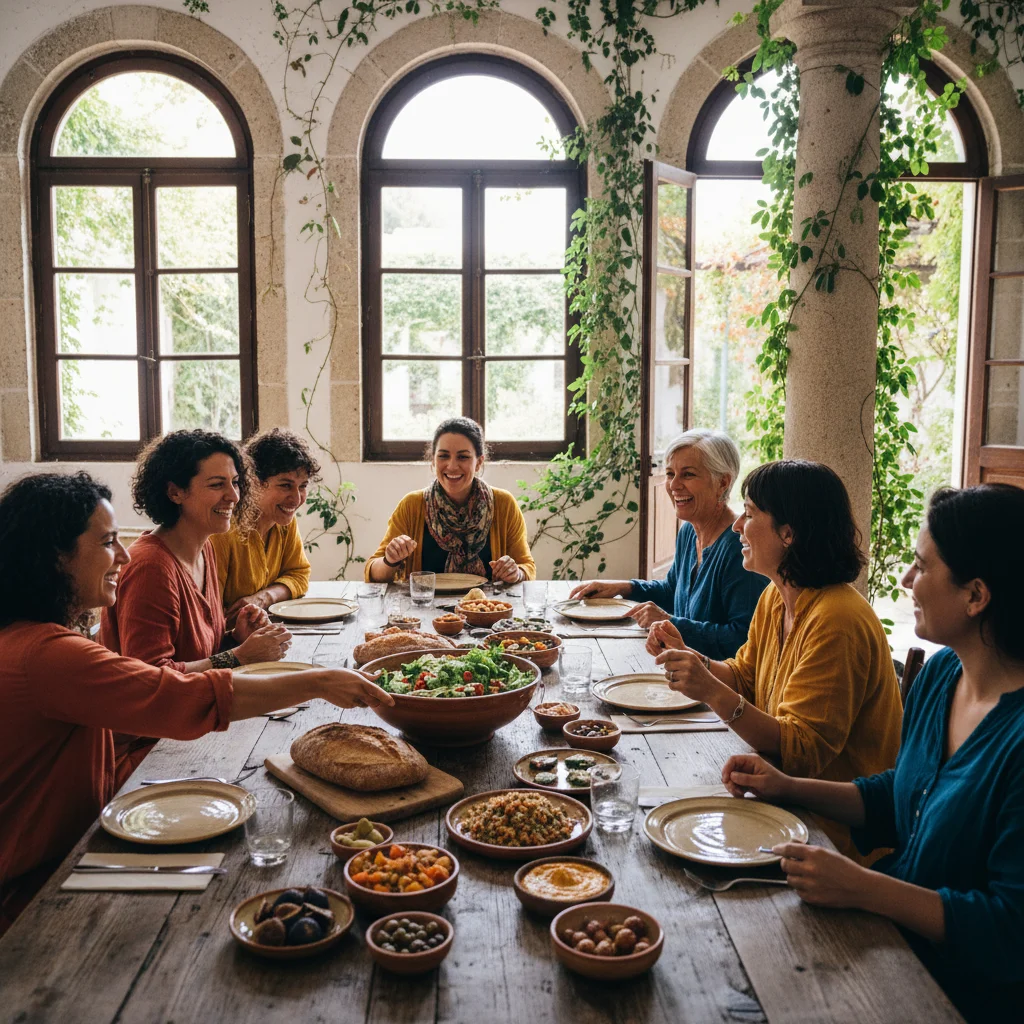
Dinner serves around 7:00 or 7:30, again as a communal experience. Portuguese retreat centers typically serve vegetarian or plant-based organic food, often sourced locally. The meal gives your group time to reconnect after the afternoon's individual processing, sharing lighter conversation before the day's final activity.
Some evenings include ceremony or ritual. This might look like a fire ceremony where you write what you're releasing on paper and burn it, a cacao ceremony that uses the heart-opening properties of ceremonial-grade cacao to facilitate sharing, or simply gathering under stars for reflection and closing the day together.
Lights out typically happens around 10:00 or 10:30, though of course you're free to stay up. Most women choose sleep. This work demands it.
The schedule intensity varies significantly across retreat styles. Some facilitators maintain a gentle pace with ample rest time, recognizing that integration happens in the pauses as much as the active work. Others structure more intensive programming with less downtime, suitable for women who feel ready for concentrated transformation and prefer immersion to gradual process. Before booking, it's worth asking the facilitator directly about daily schedule intensity and how much unstructured time you'll have.

Are These Retreats Suitable for Yoga Beginners and Solo Travelers?
The question of suitability involves both your yoga experience and your emotional readiness. Let's address both honestly.
For yoga practice level, most women's empowerment retreats in Portugal explicitly welcome beginners. Quinta Camarena in Alentejo hosts the Not So Serious Yoga Retreat described by participants as perfect for all yoga levels, with flexibility for participants to rest when tired rather than pushing through. The focus stays on what serves your body and nervous system rather than what the pose is supposed to look like.
That said, you should be comfortable with the idea of moving your body, sitting on the floor, and potentially experiencing physical discomfort as emotional material releases. Empowerment retreats use yoga as a tool for accessing feeling, which means you might cry in downward dog, shake in warrior pose, or feel rage surface during hip openers. That's not a sign you're doing it wrong. That's the work.
The solo traveler question matters more to most women considering these retreats. The majority of participants at women's empowerment retreats arrive alone. The sisterhood model depends on women coming as individuals rather than established friend groups. You're all strangers on day one, which creates equality and safety that wouldn't exist if several women already knew each other.
Rae.Earth's She Radiates retreat caps at 14 women, most arriving solo. As one participant shared, "Overall, this retreat was a fantastic opportunity for personal growth and connection. I left feeling motivated and inspired, with new friends and a clearer sense of direction." The friendship component isn't incidental. Building genuine connections with other women doing courageous work becomes part of your healing.
Room sharing arrangements vary by retreat. Some offer private room options at a higher price point. Others include shared accommodation as standard, which can feel vulnerable but also creates intimacy. You're not just spending workshop time together. You're seeing each other first thing in the morning, processing the day's events before sleep, and living in close quarters. For many women, this itself becomes healing. You witness other women's morning routines, emotional processes, and bodies in ways that challenge internalized beauty standards and competition.
Empowered Wellness Retreat designs their programming specifically for women 40+, recognizing that age-specific groups create different dynamics and address particular life stage concerns. If you're concerned about being significantly older or younger than other participants, it's worth asking facilitators about typical age range.
The vulnerability question looms largest for most women considering these retreats. You're being asked to share your story, feel your feelings in front of others, and potentially work with painful material in a group setting. That produces understandable anxiety.
Trauma-informed facilitators address this by teaching consent principles from day one. You're never required to share more than you choose. You can pass in circles. You can modify practices or sit out entirely. The invitation is to stretch your capacity for vulnerability incrementally rather than forcing breakthrough at the expense of safety.
For women with significant trauma history, choose facilitators with explicit trauma-informed training rather than standard yoga teacher certification. The difference matters immensely in how the space is held and whether you'll feel safe enough to do meaningful work.
Physical safety also matters, especially for solo travelers to rural Portugal. Reputable retreat centers provide transportation from major airports or nearby cities, give clear directions for self-drivers, and maintain secure properties. Before booking, confirm logistics including how you'll get from Lisbon or Porto to remote locations like Portalegre.
What Should You Expect to Pay for a Women's Empowerment Retreat in Portugal?
Pricing transparency remains frustratingly rare in the wellness retreat industry, but understanding typical costs helps you budget appropriately and evaluate value.
Pure Nature Yoga's 7-day Rise Empowerment Retreat in Portalegre doesn't publicly list pricing on their website, which is unfortunately common. Based on comparable 7-day women's empowerment retreats in Portugal, you should budget approximately €1,400-€2,200 depending on accommodation type. This typically includes all meals, yoga and workshop sessions, retreat materials, and use of equipment. The Manduka mats, organic blocks, bolsters, blankets, and straps they provide represent quality equipment that affects your comfort and safety in practice.
Rae.Earth's 5-day She Radiates retreat follows a shorter format that generally runs €900-€1,500 based on similar offerings. The smaller group size (maximum 14 women) means higher per-person costs than retreats accommodating 20-30 participants, but also creates the intimacy that serves deep empowerment work.
What these prices typically include: accommodation (shared or private depending on level), three vegetarian or plant-based meals daily, two or more yoga/movement sessions per day, workshops and circles, ceremonies when offered, all retreat materials, and often extras like welcome packages, closing ceremony gifts, or printed workbooks. The quality of food matters more at these retreats than you might expect. As one participant noted about her experience at Yoga Evolution Retreats, "The knowledge and practice I have gained is life changing, it was challenging and intense but I am very grateful for it. The food was also very delicious." When you're doing emotionally demanding work, nourishing meals provide tangible care that helps you stay grounded.
What you'll pay extra for: flights to Portugal (budget €100-€500 depending on origin city and season), ground transportation from Lisbon or Porto airports to retreat locations (€50-€150 for private transfers to remote areas like Portalegre, less if shared shuttles are offered), optional spa treatments or bodywork sessions, alcohol if you choose to drink during free time, and personal shopping in nearby towns.
Portugal offers significantly better value than comparable retreats in Switzerland, Norway, or even southern France. A similar 7-day women's empowerment retreat in those countries often runs €2,500-€4,000. Portugal's lower cost of living allows retreat centers to keep prices accessible while maintaining quality food, comfortable accommodation, and small group sizes.
Solo supplements vary widely. Some retreats charge 30-50% more for private rooms. Others include shared accommodation as standard with private options unavailable. A few specifically design their communities around shared rooms as part of the sisterhood experience, making private rooms feel contrary to the retreat philosophy.
Payment structures typically require deposits of €200-€500 to secure your spot, with the balance due 4-8 weeks before the retreat begins. Some facilitators offer payment plans, particularly for longer or more expensive retreats. Before committing, clarify the cancellation policy. Life circumstances change, and understanding whether you'll receive a refund or credit if you need to cancel helps you make a confident decision.
The investment feels significant, and it is. You're paying not just for yoga classes but for transformative facilitation, trauma-informed holding, small group dynamics, and a level of attention you won't find at larger retreat centers. One woman reflected on her investment this way: "I just finished a yoga retreat and it was the best experience of my life. I found this great place in Portugal that is very reasonably priced, with 2 yoga classes and 1 meditation class per day." The reasonable pricing in Portugal allows women to access this level of empowerment work who might be priced out in more expensive destinations.
What Have Women Actually Experienced at Portugal Empowerment Retreats?
Beyond the marketing language, what actually happens for women who attend these retreats? The testimonials reveal patterns worth understanding as you consider whether this journey is right for you now.
Transformation language appears consistently but means different things. For some women, transformation looks like finally crying about something they've held for years. For others, it's recognizing a pattern that's been running their relationships. For others still, it's simply feeling present in their body for the first time in memory.
Connection emerges as a near-universal outcome. "Overall, this retreat was a fantastic opportunity for personal growth and connection. I left feeling motivated and inspired, with new friends and a clearer sense of direction," one woman shared about her experience at Rae.Earth's She Radiates retreat. The friendships formed aren't just pleasant additions. They become evidence that genuine connection is possible, that your story can be witnessed without judgment, and that other women struggle with the same shame and fear you thought were yours alone.
Emotional intensity comes up frequently in honest reviews. "The knowledge and practice I have gained is life changing, it was challenging and intense but I am very grateful for it," a participant at Yoga Evolution Retreats in Central Portugal reported. Notice the sequence: life changing, challenging and intense, grateful. The intensity isn't incidental to the transformation. You can't access what needs healing without facing some discomfort. Skilled facilitators help you work at your edge without pushing past your capacity.
The challenging nature matters to understand before you book. These aren't relaxation retreats. You might have difficult realizations about relationships you need to leave or jobs that are depleting you. You might access anger you've been suppressing or grief you've been avoiding. Coming home doesn't mean your problems are solved. It means you've begun relating to them differently.
Specific practices that resonated most across testimonials include breathwork (for accessing emotion), circle work (for feeling witnessed), and somatic practices (for releasing what bodies hold). Dance and free movement get mentioned particularly by women who found traditional talk therapy insufficient for their healing.
The food quality appears surprisingly often in reviews. It's not superficial. When you're emotionally raw, the care expressed through thoughtfully prepared meals tells your system it's safe. The ritual of gathering for meals creates rhythm and normalcy alongside the intense transformation work.
Long-term integration presents the biggest challenge. The retreat creates a container unlike your normal life. You're away from responsibilities, surrounded by women focused on the same work, and held by experienced facilitators. Returning home means carrying what you've learned into environments that haven't changed. Some women report struggling with this transition, feeling isolated or frustrated that family and friends don't understand what they've experienced.
"The course exceeded my expectations entirely. Five days were perfect for achieving objectives," one woman shared about Rae.Earth's retreat. Ana Rae's qualified approach, portfolio of techniques, and caring facilitation created conditions for meaningful work. But even perfect retreats don't do the ongoing work of integration. That becomes your responsibility.
Realistic expectations help. You won't leave completely healed. You will likely leave with clearer understanding of what needs attention, some new practices for regulation and self-connection, and evidence that change is possible. For many women, that's exactly what they need to continue their journey with renewed commitment.
How Do You Choose and Book Your Women's Empowerment Retreat in Portugal?
The practical process of choosing and booking involves several concrete steps beyond simply picking what sounds appealing.
Start by identifying what you most need right now. Are you looking to process specific trauma, which suggests choosing facilitators with trauma-informed credentials like The Shanti Space? Are you seeking sisterhood and community after years of isolation, pointing toward retreats like Pure Nature Yoga's Rise Empowerment that center group connection? Are you ready for intense transformation or do you need gentler introduction to somatic healing practices?
Before booking any retreat, contact the facilitator directly with these questions:
What is your specific training in trauma-informed facilitation? Standard yoga teacher training doesn't include this. Look for additional certifications in trauma-sensitive yoga, somatic experiencing, or similar modalities.
What is the typical emotional intensity and how do you support participants who become overwhelmed? This helps you assess whether the retreat matches your capacity.
What is your cancellation and refund policy? Life changes, and you need to know your financial risk.
Can you provide references from past participants I could speak with? Reputable facilitators will offer this.
Seasonal timing affects your experience more than you might expect. Spring in Portugal (April-May) brings wildflowers and moderate temperatures ideal for outdoor practices. Summer (June-August) offers long days and warmth but can feel hot, particularly in inland regions like Portalegre or Alentejo. Fall (September-October) provides harvest energy and comfortable weather. Winter (November-March) can be quite cool, especially at night, and requires checking whether retreat centers have adequate heating.
Booking platforms versus direct booking both have advantages. Platforms like BookRetreats or Tripaneer offer reviews, comparison tools, and sometimes booking protection. Direct booking often means better communication with facilitators and occasionally lower prices since platforms take commission. Rae.Earth appears on both their own site and BookRetreats, giving you options.
Travel logistics to rural Portugal require advance planning. Most retreats in Portalegre are 2-3 hours from Lisbon's airport. Pure Nature Yoga and Shakti Cabral both operate in this region, so confirm whether they offer airport transfers or if you need to arrange rental car or bus service. Central Portugal venues like Yoga Evolution Retreats in Oleiros sit roughly two hours from Lisbon with decent road access. The Algarve coast where Empowered Wellness Retreat operates has its own Faro airport, often easier logistics for international travelers.
Packing for empowerment work differs from packing for vacation. Beyond standard yoga clothing, bring comfortable loose layers for somatic and dance work where you need full range of motion without restrictive fabrics. Pack a journal and good pen. Bring any personal ritual objects that ground you: photos, crystals, meaningful jewelry. Most retreats provide yoga mats and props, but if you have strong preferences for your own mat, Portugal is reachable by car from much of Europe, making it feasible to bring your own equipment.
Emotional preparation matters as much as practical planning. Consider starting a journaling practice before you arrive, exploring what you hope to address during the retreat. Begin noticing where you hold tension or emotion in your body. Practice being honest about your feelings, even just with yourself. The more you warm up to vulnerability before arrival, the more quickly you'll be able to access deeper work during the intensive days.
For longer stays, citizens of many countries can visit Portugal for up to 90 days without a visa. If you're considering extended time before or after your retreat to process and integrate, confirm your specific passport's requirements.
Before booking, spend time on the facilitator's website reading their philosophy and approach. The language they use tells you a lot about whether their values align with yours. Notice if you feel drawn to or resistant to their framing of women's empowerment work. That gut response offers valuable information.
The booking decision ultimately comes down to timing and readiness. You can research endlessly, but at some point you need to trust that this is the moment. If you find yourself returning repeatedly to a specific retreat, that persistent pull likely means something. Your system recognizes what it needs, even when your mind wants more certainty than is possible.
Portugal's landscape holds space for the work you've been avoiding or unable to access in your daily life. The facilitators gathering there have chosen this country for reasons that go beyond affordable venue costs: the wild beauty, the spiritual culture, the way that being surrounded by cork forests and ancient stones helps women remember what they knew before they learned to make themselves smaller.
Your next step is simple. Choose one retreat that resonates, reach out to the facilitator with your questions, and if it feels aligned, make the deposit. The vulnerability starts there, before you ever board the plane. You're saying yes to your own transformation, committing time and resources to your healing, and trusting that connecting with women doing the same brave work will shift something that needs shifting.
That decision, the one you make from your kitchen table months before you ever see Portuguese countryside, is already empowerment work. You're choosing yourself. Everything that follows builds from that foundation.